Sewer Repair in Los Angeles, CA
Cleaning alone can’t fix a damaged sewer. We diagnose the line with a camera inspection and recommend the most cost-effective repair, conventional or trenchless.
When to call for sewer repair
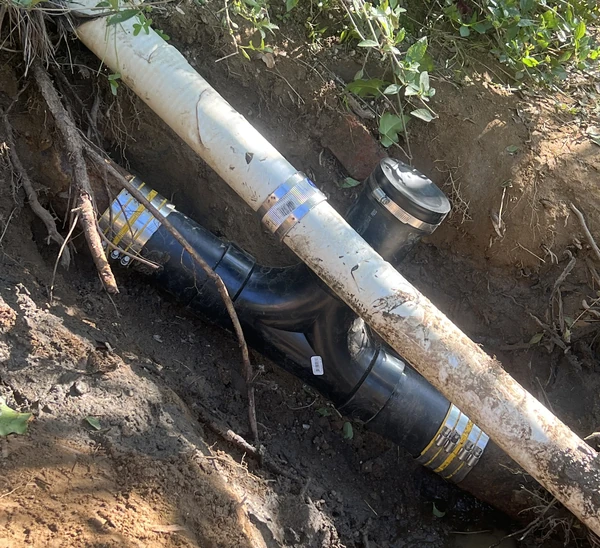
What we see on residential and commercial properties:
What actually damages a sewer line
Sewer lines rarely fail from one event. Roots are the most common cause in older neighborhoods: a hairline separation at a joint releases moisture, roots grow toward it, and once inside they thicken and catch everything moving past.
Joints fail in other ways too. Ground movement and settling pull sections out of alignment, leaving an offset, a lip where one length of pipe no longer meets the next squarely. Waste catches on that lip. Clay pipe cracks under load; cast iron corrodes from the inside until the bottom of the pipe channels out entirely.
A bellied section is different again. The pipe is intact but has settled below grade, so it holds standing water permanently. Nothing is broken, yet the line will never run clean until the slope is corrected.
Each one needs a different repair, which is why the diagnosis has to come before the quote.
Trenchless or conventional: how the choice gets made
Trenchless repair rehabilitates the existing line from access points at either end instead of opening the full run. It is the better option when the host pipe is continuous enough to line or burst through, when the run passes under a driveway, mature landscaping, or hardscape, and when depth makes open excavation expensive.
Conventional excavation is the right answer when trenchless is not viable: a fully collapsed section with nothing left to line, a belly that has to be re-graded, a spot failure shallow and accessible enough that digging is cheaper, or a line whose alignment needs changing.
Neither is universally better. The camera footage, the depth, and the access at the site decide it. Where the line can be rehabilitated without excavation, trenchless sewer repair usually means less restoration work afterward.
Why the camera comes before the quote
A sewer camera inspection establishes where the fault is, what kind of fault it is, and how much of the run is affected. Everything after that depends on those answers.
Without that, a quote is guesswork. A single cracked joint eight feet out and a lateral that has lost its grade for thirty feet produce identical symptoms at the fixture and cost very different amounts to fix.
It also identifies the lines that do not need repair at all. Some backups that look structural are heavy buildup that clears with hydro jetting or sewer cleaning.
Residential laterals and commercial mains
A house lateral is usually a single run from the building to the city main, and one fault takes the whole property offline. Repair is disruptive but bounded.
Commercial and multi-unit properties add scale and constraint. Several stacks may feed one main, so isolating the fault matters more. Work often has to be staged around operating hours, and access can involve parking areas, tenant spaces, or shared easements. On a restaurant line, grease loading also means what presents as a structural failure is sometimes chronic buildup.
Sewer lines under Los Angeles homes
A large share of the housing stock we work on has vitrified clay laterals to the street, joined in short sections. Clay is durable but its joints are the weak point, and decades of ground movement work them apart.
The street trees that define these neighborhoods do the rest. A lateral crossing a parkway runs directly through the root zone of a mature tree, and roots reliably find the moisture at a separated joint. On hillside lots, long runs and steep grade changes add their own stresses and make access for excavation considerably more expensive, which often tips the decision toward trenchless.
Sewer Repair FAQ
Can a sewer line be repaired without digging up the yard?
Often, yes. If enough of the host pipe remains continuous, trenchless methods rehabilitate the line from access points instead of opening the full run. Whether it applies to your line depends on what the camera shows. A fully collapsed section or a belly that needs re-grading generally still requires excavation.
How do I know whether I need repair or just cleaning?
Cleaning solves buildup. Repair solves structure. The signal to watch is recurrence: if a line backs up again soon after a proper cleaning, or the camera shows roots, cracks, offsets, or standing water in a level section, the problem is structural and cleaning will only buy time.
Is a sunken patch in the yard a sewer problem?
It can be. Water escaping a broken line washes out the soil supporting it, and the surface settles above the fault. It is worth investigating, though it is not proof on its own; irrigation faults and general settling look similar from above.
Who is responsible for the line, me or the city?
Responsibility usually splits at the property line or the city main, with the lateral that serves your building on your side of the boundary. The exact division varies, so confirm it with your municipality before work is scheduled.
How soon can someone come out?
We are available 24 hours a day, Monday through Sunday. Call (323) 303-0060 and we will give you a straight answer about when we can be there.
Our process
Ready for sewer repair?
Call now or request service. We serve LA and the San Fernando Valley.