
Repiping Services in Los Angeles, CA
Repeated supply leaks, corrosion, or a history of slab leaks usually mean the system itself is failing. Repiping brings back reliable pressure and water quality.
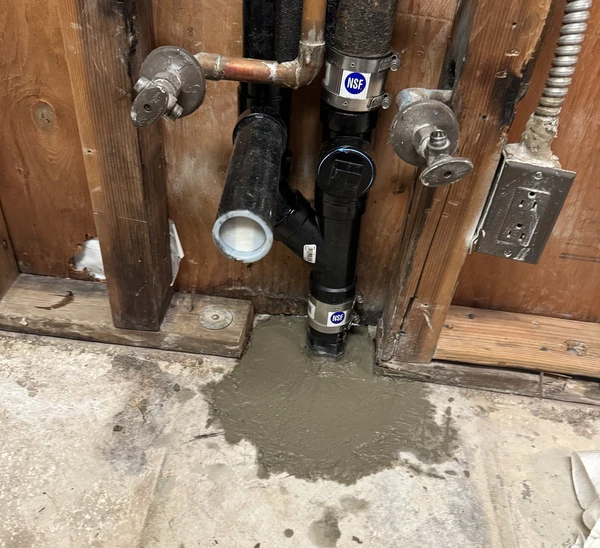
When to call for repiping services
What we see on residential and commercial properties:
How to tell a system failure from a pipe failure
A single leak is an event. A pattern of leaks is a condition, and the condition is what repiping fixes.
Pinhole leaks in copper are the clearest pattern signal. They start on the inside, where water chemistry, velocity, and age thin the wall until it perforates. Because the whole system shares those conditions, a first pinhole usually means others are forming. Galvanized steel fails differently but just as systemically: it corrodes from within, narrowing the bore and shedding rust, which produces discolored water and pressure that has declined slowly for years.
A second slab leak on the same property is the other common trigger. One failure under a slab can be an unlucky section. Two points to a distribution system that has reached a similar condition throughout.
Copper, PEX and CPVC
Material choice deserves an actual decision.
Copper is rigid, long established, and tolerant of heat, and most of the housing stock here already has it. It is the most labor-intensive to install, and it remains susceptible to the same water chemistry that thinned the original.
PEX is flexible, which is its main practical advantage. It can often be routed through existing cavities with far less demolition, and fewer fittings means fewer joints that can fail. It is not run outdoors in sunlight and is generally kept away from direct heat sources.
CPVC is rigid, handles hot water, and does not share the pinhole corrosion mechanism that affects copper. It is more brittle than PEX, so it needs support and care where movement is expected.
Which one is right depends on the routing available, whether the walls are open anyway, and the water conditions behind the original failure.
How disruptive it actually is
Repiping replaces the distribution system, so access is the whole question. What varies is how much has to be opened to reach the pipe.
A property with accessible attic, crawlspace, or basement routes can often be repiped with limited, targeted openings. A slab-on-grade home with finished walls and no overhead route is the harder case, and that is where rerouting through walls and ceilings has to be planned carefully in advance.
Water is shut off in stages instead of for the whole job, and the sequence is planned around that. Expect patching and repainting afterward; that is a real part of the job and should be in the plan from the start.
Repiping part of a system
It does not have to happen all at once. Where failures are concentrated, such as the hot side, one wing of a building, or the run under a slab, replacing that portion can be the proportionate answer.
The judgment is whether the untouched portion shares the condition that caused the failure. If it is the same material, same age, and same water, partial work postpones the problem instead of resolving it. If the failing section is genuinely distinct, say the hot line under a slab while the rest runs overhead in newer material, a reroute of just that section is often the better economics.
Why repiping comes up often in Los Angeles
Two overlapping groups of buildings drive it here. Pre-war properties that still carry original galvanized supply are well past the point where internal corrosion shows up as rusty water and weak pressure. The very large post-war tract housing stock, plumbed in copper, has reached the age when pinhole leaks start appearing.
Local water is mineral-rich, which contributes on both counts, and slab-on-grade construction concentrates the consequences. A supply line under concrete is both more likely to fail unnoticed and more expensive to reach when it does.
Repiping FAQ
How do I know I need repiping rather than another repair?
Repetition is the signal. Repeated pinhole leaks, a second slab leak, rusty water at multiple fixtures, or pressure that has declined steadily for years all point at the system, not at a single failure. One isolated leak in an otherwise healthy system is a repair.
Do I have to move out?
Usually not. Water is shut off in stages instead of for the whole job, and the work is sequenced so the property stays usable. How disruptive it feels depends mostly on how accessible the routing is.
Is PEX as good as copper?
For most residential supply work it performs well, and its flexibility often means far less demolition, which is a genuine advantage. Copper remains the more traditional choice and handles heat well. Neither is universally better; the routing available and the water conditions decide it.
Can you repipe just the hot side?
Sometimes, and it can be the sensible answer when failures are concentrated there, which is common since hot lines fail first. It is worth doing only when the cold side is genuinely in different condition, not merely untested.
How soon can someone come out?
We are available 24 hours a day, Monday through Sunday. Call (323) 303-0060 and we will give you a straight answer about when we can be there.
Our process
Ready for repiping services?
Call now or request service. We serve LA and the San Fernando Valley.