Faucet Installation in Los Angeles, CA
We install your faucet with new supply lines, correct torque and a tested seal, then remove the old one cleanly.
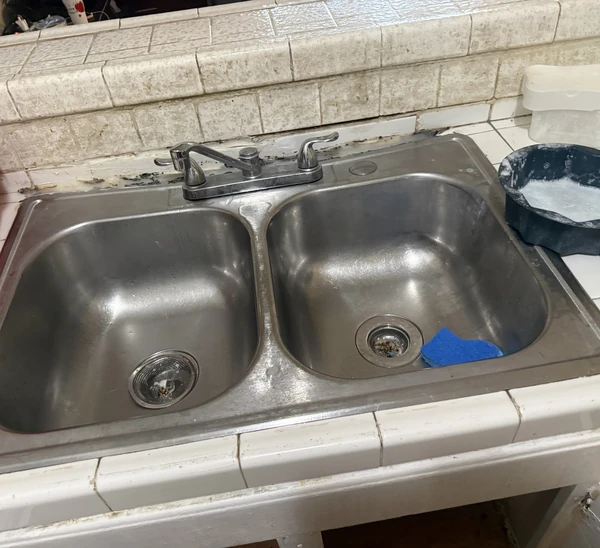
When to call for faucet installation
Common signs we see on residential and commercial properties:
What actually goes wrong with a faucet swap
Replacing a faucet looks simple, but the trouble is almost never the faucet itself.
It is usually the shut-off valve under the sink. Valves that have not been turned in fifteen years often will not close fully, or will not reopen without weeping afterwards. Finding that mid-job means shutting the water off at the main, and the valve becomes part of the work.
The second is the existing connections. Corroded supply nuts and mounting hardware seize, and forcing them turns a simple swap into a damaged sink or a cracked supply stub.
That is why old supply lines and questionable shut-offs get replaced as a matter of course rather than reused. They are inexpensive, and they are the parts that fail into the cabinet later.
Making sure the faucet fits before it is bought
Three things determine whether a given faucet will physically fit, and all are worth checking before purchase.
Hole count and spacing: sinks and countertops are drilled for one, three or four holes, and a widespread faucet needs different spacing than a centerset. A deck plate can cover extra holes, but a faucet that needs more holes than the sink has is a bigger problem.
Reach and height, especially in kitchens: a tall spout over a shallow sink splashes, and a short reach over a large basin will not clear the far side.
Accessories matter too: a soap dispenser, side sprayer or filtered-water tap each need their own hole, which is often what forces the hole-count decision.
Why leaks appear after a DIY install
Most post-install leaks come from one of three places, and avoiding all three needs no special tools, just knowing where to look.
Over-tightening is the most common. Supply connections seal on a washer or a compression fitting, not on force, and over-torquing distorts the seal or cracks a plastic nut, which weeps days later.
The second is the seal between the faucet base and the deck, which keeps splash water out of the cabinet. It is easy to disturb while positioning the faucet, and when it fails the sign is a damp cabinet base rather than a visible drip.
The third is not testing under pressure long enough. A slow weep needs several minutes at full pressure to show. That is the difference between a finished job and a call back, and if a cabinet has already been damp for a while, it becomes a leak detection question instead.
Hard water and faucet lifespan here
Los Angeles water is mineral-rich, which shortens the working life of the parts inside a faucet. Cartridges and valve seats collect deposit, and that is what makes a handle stiff, a drip return after a cartridge change, or a spray head lose its pattern.
Aerators are the visible version and the easiest fix: unscrewing and clearing one restores flow that people assume is a pressure problem.
When deposit affects fixtures throughout the property rather than one tap, the water is the cause rather than the faucets. That is worth raising while we are on site, so the same fixtures do not get replaced repeatedly.
Faucet Installation FAQ
Can I supply my own faucet?
Yes, that is common. Check hole count and spacing against your sink before buying, since that is the one incompatibility that cannot be worked around easily.
Why does my new faucet drip already?
Usually the cartridge is not seated correctly, or a connection was over-tightened and the seal distorted. Occasionally it is debris from the install caught in the valve seat. All of these can be fixed without replacing the faucet.
Should the shut-off valves be replaced at the same time?
If they are old, stiff or weep when operated, yes. They are inexpensive, they are already exposed during the work, and a valve that will not close is what turns a future small leak into a whole-house shutdown.
My water pressure dropped after a new faucet. Why?
Most often the aerator is catching debris dislodged during the install, or the supply valve is not fully open. Both are quick to check before assuming something is wrong with the faucet.
How soon can someone come out?
We are available 24 hours a day, Monday through Sunday. Call (323) 303-0060 and we will tell you honestly when we can be there.
Our process
Ready for faucet installation?
Call now or request service. We serve LA and the San Fernando Valley.