Garbage Disposal Installation in Los Angeles, CA
We install garbage disposals properly grounded, sealed at the sink flange, and tied into the drain — quiet, secure, and ready to use.
When to call for garbage disposal installation
Common signs we see on residential and commercial properties:
Why disposals fail
Most disposal failures fall into three groups, and only one of them requires a new unit.
A jam is the most common: something the unit cannot break down has stopped the impellers. The motor hums but does not turn, and most units have a reset button and a hex socket underneath to free the flywheel manually.
Electrical failure is the second — a tripped reset, a failed switch, or a motor that has burned out. The first two are cheap; the third means replacement.
The third is leaking, and where it leaks decides everything. A leak at the sink flange or the drain connections is a seal problem and repairable. A leak from the body of the unit means the housing has corroded through, and that is not repairable.
What actually damages one
Disposals grind; they do not dissolve. Two categories cause most of the damage.
Fibrous material — celery, corn husks, onion skins — wraps around the impellers rather than breaking apart. Starchy volume like potato peel or rice forms a paste that packs into the chamber and then into the drain line.
The other is fats, oils and grease, which pass the unit as liquid and solidify further down the pipe where the disposal is no longer any help. That is a drain cleaning problem the disposal simply relocated.
Cold water while running matters for the same reason: it keeps fats solid so they are ground and flushed rather than coating the line downstream.
Sizing and what the install involves
Motor size determines what a unit handles without jamming. A small unit in a household that cooks a lot jams frequently — the fix for repeated jamming is often capacity rather than technique.
Sound insulation is the other real difference between models, and it is the one people notice daily.
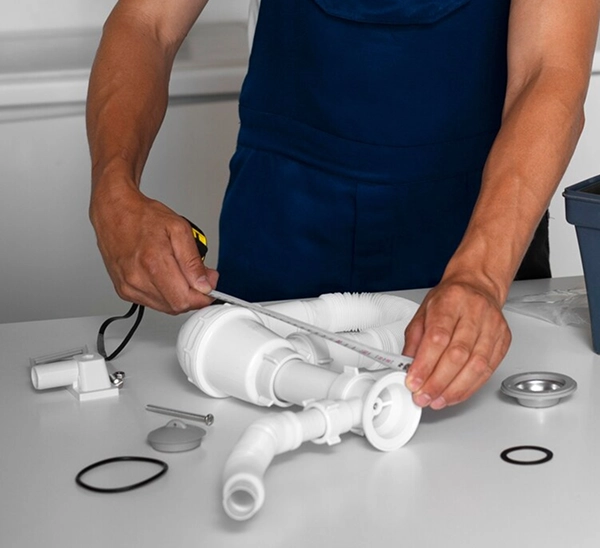
The installation itself hangs on the sink flange being sealed correctly and the drain connections being properly aligned. Mounting is the part that leaks when rushed, since it seals against the sink under the weight of the unit.
Dishwasher connection is a common detail: where a dishwasher drains through the disposal, the knockout plug in the inlet has to be removed — a new unit ships with it in place, and leaving it is the classic reason a dishwasher will not drain after a disposal swap.
Garbage Disposal FAQ
My disposal hums but will not turn. Is it dead?
Usually not. That is the signature of a jam — the motor is energised but the flywheel cannot move. Most units have a hex socket underneath to free it manually and a reset button. If it turns freely afterwards, the unit is fine.
What should never go down a disposal?
Fibrous vegetables that wrap rather than break, large volumes of starchy waste that paste together, bones and hard shells, and fats or oils. The last are the most consequential, because they pass the unit and solidify in the drain line.
Hot or cold water while running it?
Cold. It keeps fats solid so they are ground and carried away rather than melting and coating the pipe downstream.
My dishwasher will not drain after a new disposal was fitted. Why?
Almost always the knockout plug in the disposal’s dishwasher inlet. New units ship with it in place and it has to be removed during installation.
How soon can someone come out?
We are available 24 hours a day, Monday through Sunday. Call (323) 303-0060 and we will tell you honestly when we can be there.
Our process
Ready for garbage disposal installation?
Call now or request service — we serve LA & the San Fernando Valley.