Sewer Cleaning in Los Angeles, CA
When more than one fixture is slow or backing up, the issue is likely in the main sewer line. We clear blockages and inspect to confirm the cause.
When to call for sewer cleaning
Common signs we see on residential and commercial properties:
Why several fixtures failing at once means the main line
Fixtures in a building do not drain independently for long. Each runs to a branch, and the branches join a main line out to the street. A blockage in a branch affects the fixtures on that branch. A blockage in the main affects everything upstream of it.
That is why the diagnostic signal is connection rather than severity. A toilet flush that makes a nearby tub gurgle means air is being displaced through a shared path. A shower that backs up when the washing machine drains means both are meeting the same restriction. A floor drain producing wastewater means the level has risen past the lowest opening in the system.
A single slow sink with everything else normal is a branch problem. Fixtures that respond to each other are a main-line problem, and the two are cleared differently.
How a main line gets cleared
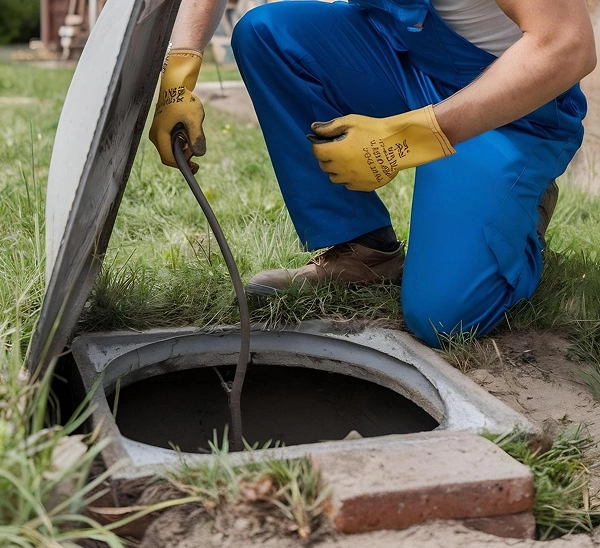
Access comes first. Main-line work runs through a cleanout, and where one is missing or buried, establishing access is part of the job rather than an afterthought.
Method follows the cause. A discrete obstruction responds to cabling, which drives a head through the blockage and restores flow. Buildup coating the pipe wall — grease, scale, soap — is what hydro jetting addresses, because it scours the full diameter instead of boring a channel through the deposit.
Roots are cleared mechanically, but cutting them back does not close the opening they came through. That is a structural finding, and it is why a camera inspection usually follows a root clearance.
Cleaning versus repair
Cleaning solves accumulation. Repair solves structure. The signal that separates them is how long a properly cleared line stays clear.
A main cleared of genuine buildup should run well for a long time. If it backs up again within weeks or a few months, the cause was not what was removed — it is more likely roots re-entering at a joint, an offset catching solids, or a bellied section holding water. Those are sewer repair questions, and repeated clearing of a structurally failed line is money spent on the symptom.
Commercial and multi-unit mains
Shared systems change the stakes. In a multi-unit building several stacks feed one main, so a blockage affects tenants who did not cause it and cannot resolve it, and access often involves common areas or another tenant’s space.
Restaurant and commercial kitchen mains fail on grease and on volume, and the failure tends to arrive during service. Those lines generally belong on a maintenance interval set from how the line actually behaves rather than cleared reactively.
Main lines under Los Angeles properties
The lateral from an older building to the street is commonly jointed clay, and its joints are where both roots and offsets appear. Inside the building, cast iron corrodes and narrows, so the same volume of waste moves through a smaller bore each year.
Mature street trees along the parkway are the reliable local aggravator — a lateral crossing that root zone will be found. On hillside lots, long runs and grade changes make bellies more likely, and a belly presents as a recurring main-line backup that cleaning never permanently fixes.
Sewer Cleaning FAQ
How do I know it is the main line and not one drain?
Look for fixtures responding to each other. A toilet that makes a tub gurgle, or a shower that backs up when the washing machine drains, means both meet the same restriction downstream. One slow fixture with everything else normal is a branch problem.
Is it safe to keep using water until you arrive?
If wastewater is already backing up into the building, minimise use — every fixture adds to what has nowhere to go. If the symptom is only slow drainage, normal light use is generally fine until the line is cleared.
Will cleaning fix a root problem permanently?
No. Roots can be cut back, and flow returns, but the opening they entered through is still there and they grow back toward it. Clearing buys time; closing the entry point is a repair.
How often should a main line be cleaned?
A sound residential main should not need a schedule — if it does, something structural is usually driving it. Commercial kitchen lines are the opposite: grease loading makes a planned interval the sensible approach.
How soon can someone come out?
We are available 24 hours a day, Monday through Sunday. Call (323) 303-0060 and we will tell you honestly when we can be there.
Our process
Ready for sewer cleaning?
Call now or request service — we serve LA & the San Fernando Valley.