Commercial Plumbing Construction in Los Angeles, CA
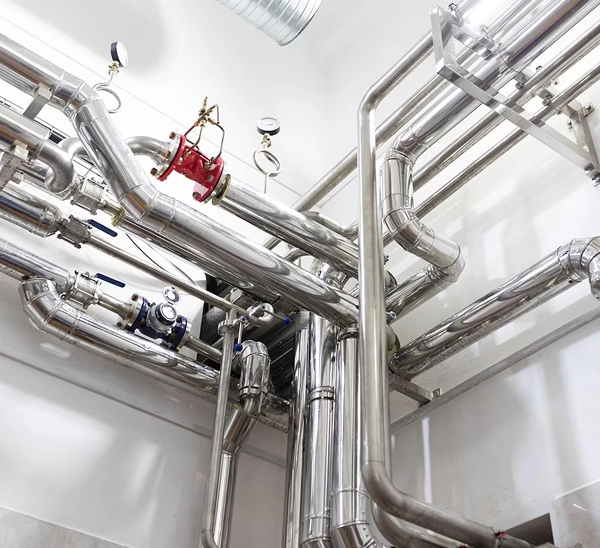
We collaborate with GCs, architects, and owners on new construction and major remodels — from underground rough-in to final fixture set.
When to call for commercial plumbing construction
Common signs we see on residential and commercial properties:
The phases, and why the early ones decide the schedule
Commercial plumbing runs in a sequence that other trades depend on, and the early phases are the ones with no margin for rework.
Underground rough-in goes in before the slab is poured. Once concrete is over it, changing anything means cutting the slab — so the drainage layout, sleeve locations and invert elevations have to be right against the plan the first time, and verified before the pour.
Top-out follows the structure: waste, vent and water piping run in walls and above ceilings before they are closed. Then final fixture set, at the end, when the space is finished enough to receive fixtures without damaging them.
Each phase has an inspection gate before the next trade covers the work. Missing one is what turns a scheduling problem into a demolition problem.
Coordination is most of the job
On a build-out, plumbing shares ceiling and wall space with mechanical, electrical and fire protection, and gravity drainage is the least flexible of them — waste lines need continuous fall, so they cannot simply route around a conflict the way conduit can.
That means plumbing routing is resolved early against the other trades, not negotiated in the field when two systems arrive at the same joist bay. Where slopes, structural penetrations and equipment locations are agreed up front, the field work is quick. Where they are not, someone loses a week.
The practical version is being reachable during design and coordination rather than only at install.
Submittals, inspections and as-builts
Three documentation obligations sit alongside the physical work, and each has a point in the schedule where it becomes urgent.
Submittals confirm the fixtures and materials to be installed match what was specified and approved, before anything is ordered — a rejected submittal after delivery is a lead-time problem.
Inspections gate each phase: underground before pour, rough before cover, final before occupancy. And as-builts record what was actually installed where, which matters to whoever maintains the building afterwards. That is the document people wish they had the first time something has to be located behind a wall.
Where new construction differs from working in an existing building
New construction is open and sequential: nothing is in the way, and the constraint is coordination with other trades and the schedule.
Work in an occupied or partially finished building is the opposite — the constraint is what already exists and cannot be disturbed. Existing lines have to be located, isolated and often rerouted around, and other tenants may share the systems being worked on. That is closer to tenant improvement work, and it is planned differently.
Confirming which situation a project actually is, early, avoids pricing and scheduling it as the wrong one.
Working with GCs, architects and owners in Los Angeles
Projects here carry local permitting and inspection requirements that shape the schedule as much as the construction does, and inspection availability is a real dependency rather than a formality.
Backflow prevention, grease interceptor sizing for food service, and accessibility requirements at fixtures all get looked at, and all are cheaper to resolve on paper than in the field.
For a project brief, drawings or a walk-through, call (323) 303-0060 with the scope and the target dates.
Commercial Construction FAQ
When should the plumber be brought in?
During design and coordination, not at install. Gravity drainage is the least flexible system in the building, so resolving routing, slopes and penetrations early prevents the conflicts that cost schedule later.
What happens if underground rough-in is wrong?
It means cutting the slab, which is why that phase is verified against the plan and inspected before the pour. It is the one phase where getting it right the first time is not just preferable but materially cheaper.
Do you handle permits and inspections?
Permit and inspection support is part of the scope on this kind of work — including phase inspections at underground, rough and final. Confirm the specifics for your project when scoping it.
Can you work to our construction schedule?
That is the normal expectation on a build-out, and it is why sequencing and trade coordination get agreed up front. Call with the scope and target dates and we will tell you what is realistic.
How soon can someone come out?
We are available 24 hours a day, Monday through Sunday. Call (323) 303-0060 and we will tell you honestly when we can be there.
Our process
Ready for commercial plumbing construction?
Call now or request service — we serve LA & the San Fernando Valley.