Water Line Services in Los Angeles, CA
A main line that leaks, loses pressure or fails affects the whole property. We repair, replace and upgrade water service lines with durable materials.
When to call for water line services
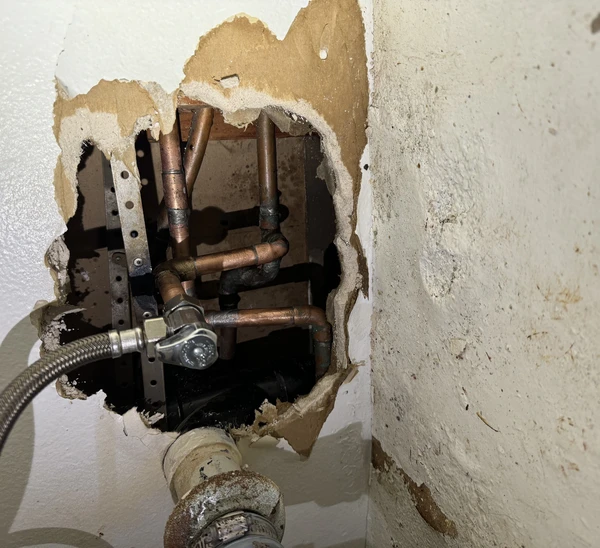
Signs we see on homes and commercial properties:
Where the service line fails and why
The service line runs from the meter to the building. It fails differently from the pipe inside the house because it sits in different conditions.
Galvanized service lines corrode from the inside, narrowing the bore until pressure at the fixtures is noticeably down. The decline is gradual enough that most people stop noticing it. Aggressive soil attacks older copper lines from the outside, and corrosion can work from within as well. Polybutylene, used during certain periods, has a well known failure history.
The other cause is mechanical. Soil movement, settling and nearby roots stress a buried line, and pressure surges break it at whatever point is already weakest.
Repair or replace the run
A single failure on a line that is otherwise sound calls for a repair: expose the fault, replace that section and restore the surface.
Replacement makes more sense when the material or age of the line means another failure is only a matter of time. Replacing a corroded galvanized service removes the cause of the leaks that line would keep producing, and it usually restores pressure that has been low for years.
The pipe is rarely the main cost. What the line runs beneath matters more: a run under a driveway, mature planting or hardscape adds restoration costs that often exceed the plumbing work, which is why trenchless replacement is worth considering on those sites.
Reading the symptoms correctly
A wet patch in the yard, or water seeping through pavement when there has been no rain and no irrigation running, is the clearest sign. Water escaping a buried line surfaces along the easiest path, which can be some distance from the fault.
Pressure loss at every fixture at once points to the service line, since a problem that affects the whole property sits upstream of the whole property. Pressure loss at one fixture does not. A high bill with no fixture leak follows the same logic: leak detection with a meter test will show whether water is leaving the system continuously.
A sudden drop, as opposed to a gradual one, suggests a break instead of corrosion. A break loses water fast enough that it should be treated urgently.
Where responsibility divides
A boundary usually applies: the utility owns the main and usually the meter, and the property owner owns the service line from that point to the building. A leak on your side is yours.
The exact division varies by municipality, so confirm it before work is scheduled. Occasionally what looks like a private service leak is upstream of the boundary and is the utility’s to fix.
Service lines under Los Angeles properties
Older properties here still carry galvanized service lines that are well past the point of internal corrosion. The usual complaint is pressure that has been mediocre for as long as anyone remembers, and a replacement typically fixes it.
Expansive soils that move with the seasons, and hillside settling, both affect buried lines. Mature street trees add root pressure along the parkway, which is where most service lines run between the meter and the building.
Water Line FAQ
How do I know the problem is the service line and not inside the house?
Scope is the clue. Low pressure at every fixture at once, or a wet area in the yard between the meter and the building with no irrigation running, points upstream. A problem at one fixture does not.
Is a wet patch in the yard always a water line leak?
No. Irrigation faults look very similar from the surface. Isolating the irrigation and watching the meter separates them quickly, and that is worth doing before anything is excavated.
Can a service line be replaced without trenching the yard?
Often, depending on the route and the soil. Where the run passes under a driveway or established landscaping, trenchless replacement is usually the cheaper total job because it avoids the restoration cost.
Will replacing the line improve my water pressure?
If the current line is corroded galvanized, usually yes, because the bore has narrowed and replacement restores it. If the line is sound and the pressure problem is elsewhere, replacing it will not help, which is why the cause is confirmed first.
How soon can someone come out?
We are available 24 hours a day, Monday through Sunday. Call (323) 303-0060 and we will tell you honestly when we can be there.
Our process
Ready for water line services?
Call now or request service. We serve LA and the San Fernando Valley.