
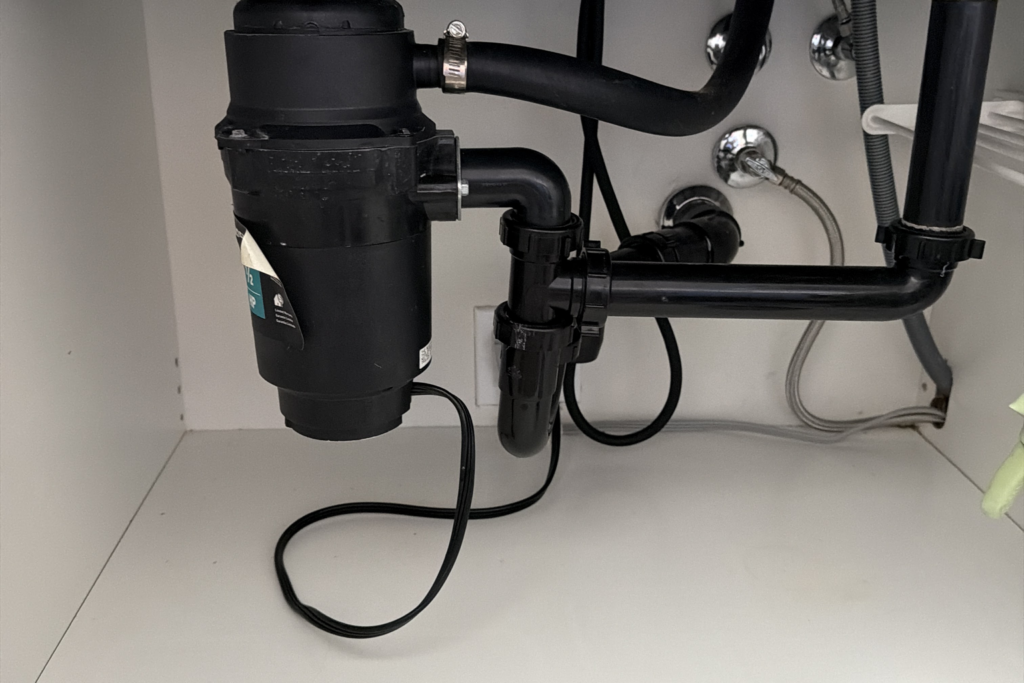
If your garbage disposal’s reset button trips again shortly after you press it, the unit is telling you that something is still wrong. The button is a safety device. It pops out when the motor draws too much current, overheats, or loses its power path. Pressing it back in restores power only if the cause has cleared. When it trips a second time, the cause is still there, and continuing to reset it can damage the motor or leave you working near live electrical parts.
The safest next step is to stop using the disposal, leave it off, and have a qualified plumber or electrician look at it. They can separate a simple obstruction or loose connection from a failing motor or internal fault, and tell you whether the unit is worth repairing or needs replacement.
What the reset button does
The reset button is an overload protector built into the disposal. When the motor pulls more current than it should, or gets hot, the protector cuts power to keep the motor from burning out. A tripped button is a symptom, not the problem itself. It points to one of several possible conditions:
- A jam in the grinding chamber that stalls the motor
- Overheating after repeated or heavy use
- A failing motor or worn internal components
- A problem with the wall switch, outlet, GFCI, or the circuit serving the disposal
- Moisture or water near electrical connections
These causes look similar from the outside, but they call for very different responses. That is why a disposal that trips repeatedly should be diagnosed instead of reset over and over.
Why it keeps tripping after one reset
A single cautious reset is reasonable when a disposal has overloaded once. If the button trips again right away, or again after a few seconds of running, the overload is still there. Common patterns include:
- Trips immediately when switched on. The motor may be jammed, seized, or shorted, or the circuit may be faulting.
- Runs briefly, then trips. The motor may be overheating, working against a partial obstruction, or drawing excess current because of internal wear.
- Trips only after extended use. Heat buildup from repeated or heavy loads may be pushing the protector past its limit.
- Trips along with a GFCI or breaker. The fault may be electrical rather than mechanical, which is a job for a qualified electrician or plumber trained in this work.
None of these can be confirmed without inspecting the unit and its circuit. Guessing can lead to replacing a disposal that only needed a repair, or repairing one that is at the end of its life.
Safe observations you can make
You can gather useful information without reaching into the grinding chamber, resetting the unit repeatedly, or touching electrical parts. From a dry, safe spot with the disposal switched off:
- Note the sound when it runs: humming without spinning, a grinding noise, a click, or silence.
- Note the timing: does it trip instantly, after a few seconds, or after minutes of use?
- Note recent use: what was put down the disposal, and how much, before the problem started.
- Check whether the sink drains normally or holds water.
- Look for any visible water, moisture, or drip under the sink, near the disposal or its connections.
- Note whether a GFCI outlet or a breaker also tripped.
Write these details down. They help a professional narrow down the cause quickly and skip unnecessary work.
What not to do
A few common instincts make the situation worse or unsafe:
- Do not keep pressing the reset button in a cycle of reset and trip.
- Do not reach into the grinding chamber, even with the power off.
- Do not pour water into a unit that is not draining, and do not run it while it holds water.
- Do not attempt electrical repairs, bypass the reset, or alter the outlet, switch, or breaker.
- Do not use the disposal if you see water near electrical connections. Leave the power off and call for help.
How a professional evaluation works
A qualified plumber or electrician will start by confirming the power path and the condition of the unit. That usually means checking the switch, outlet, GFCI, and circuit, then inspecting the disposal for jams, obstructions, worn components, or internal damage. The aim is to find the cause rather than treat the symptom.
Once the cause is known, the choice is usually repair or replace: fix what can be safely repaired, or replace the disposal when the motor or internal assembly has failed. A professional can explain which applies to your unit and why, and can handle the work safely, including any electrical connections involved.
If you are in Los Angeles and your disposal keeps tripping, you can request garbage disposal repair or installation and have the unit evaluated. For broader plumbing concerns around the kitchen, plumbing repair services cover related issues. You can also check the Los Angeles service area and contact the company to arrange a visit.
When to stop and call for help
Stop using the disposal and call a professional if any of these apply:
- The reset button trips more than once.
- The unit hums but does not spin, or makes unusual noises.
- The sink does not drain, or water backs up.
- You see water or moisture near the disposal, outlet, or wiring.
- A GFCI or breaker trips when the disposal is used.
- You smell burning, or the unit feels unusually hot.
These signs point to conditions a qualified professional should diagnose. Leaving the power off while you wait for an inspection protects both the equipment and your home.
Frequently asked questions
Can I just keep pressing the reset button?
No. If the button trips again after one cautious reset, the cause is still present. Repeated resetting can damage the motor and leaves the cause untouched.
Does a tripped reset button always mean the disposal is broken?
Not always. It can point to a jam, overheating, a circuit or switch issue, or moisture near electrical connections. Only an inspection can confirm which one applies.
Can I fix a jammed disposal myself?
Reaching into the grinding chamber is unsafe, even with the power off. A professional can clear an obstruction safely and check for damage at the same time.
Will I need a new disposal?
Sometimes a repair is enough. When the motor or internal assembly has failed, replacement is the better option. A professional can determine which after evaluating the unit.
What should I do while I wait for help?
Leave the disposal switched off, do not run water into a unit that is not draining, and keep the area dry. If you see water near electrical parts, keep the power off and call for service.